 Ayuda Trámites
Check your case file in infoext2 with your NIE or 15-character case number. Also check every notification. If you receive a document request, answer before its deadline. If approved, book your TIE appointment within one month. If refused, read the appeal information and act before the stated deadline.
Closed deadline and process figures
The deadline ended on 30 June 2026. No new applications are accepted. This guide is for people who applied and are waiting for an answer.
On 2 July 2026, La Moncloa reported 1.174.978 applications received and 609.737 case files processed. Of these, 79,6 % were for the arraigo extraordinario route (the extraordinary regularisation itself). The remaining 20,4 % were from international protection applicants.
By 31 August 2026, 337.917 people from the regularisation process were registered with Social Security. La Moncloa reported this figure on 2 September 2026.
How to check your case file
- Open infoext2. Use the official immigration case status platform. The website address is infoext2.delegaciondelgobierno.gob.es.
- Enter your details. You can use your NIE. It starts with X, Y or Z, has eight digits and ends with a letter. You can also use your 15-character case number with your identification details.
- Check by SMS. Send NIE followed by your number, or EXPE followed by your case number, to 651 714 610. Leave one space between the word and the number.
- Check notifications. They go to the address or channel in your application. If you chose electronic notices, check DEHú, the government's electronic mailbox. If a representative filed the application, they normally receive the notices. Check your email, DEHú and post.
The online result is for information only. It does not replace the official notice. Don't file a second application. Applications are not always processed in date order. A later case moving forward does not mean your case has a problem.
If you have an NIE but did not receive the admission letter, check infoext2. The admission may appear there. If it does not, report the problem through the immigration service for reporting problems. Include your case number.
What each status means
- Admitted for processing / comunicación de inicio (start-of-procedure notice). From this notice, you are provisionally authorised to live and work as an employee or self-employed person throughout Spain. If you did not have a Social Security number, one is assigned automatically.
- En trámite (being processed). The application is registered and under review. There is no decision yet. You don't need to do anything except check your notifications.
- Requerido (documents requested). The administration wants documents or a correction. You must answer the requerimiento (request for documents) within the notice deadline.
- Resuelto favorable (approved). The authorisation has been granted. Follow the next section.
- Resuelto desfavorable (refused). The application was rejected. Check your possible appeals.
- Archivado (closed). The administration treats the application as withdrawn. This often happens when you do not answer a document request on time. It can also happen after three months of delay caused by you.
The exact wording on screen can change. If you are unsure, the official notice takes priority.
If you receive a document request
The Processing Unit sends a document request when documents are missing or something needs correcting. The notice gives you the deadline. It can never be more than 15 days. If you do not answer on time, the administration treats you as withdrawn and closes the case.
Don't wait until the last day. Send the documents preferably through MERCURIO (the online document service), with a digital certificate or Cl@ve. You can also go without an appointment to an authorised Correos office. In-person subsanación (correcting or completing the application) through Correos is available until 30 September 2026. Keep proof of every submission.

If the decision is favourable
- Read the decision. Check your details. If you work as an employee, tell your employer at once. If you applied for international protection, withdraw that application or any pending appeal when you apply for the TIE.
- Book your fingerprint appointment. Ask for it at the National Police within one month of the grant. See our immigration appointment guide.
- Pay the card fee. The tasa (immigration fee) 790 code 012 is 16,08 euros for the first TIE for temporary residence, under Order PJC/617/2025. Check the current amount before paying. The 790 code 052 fee is for the application, which you have already paid. Code 012 is for the card.
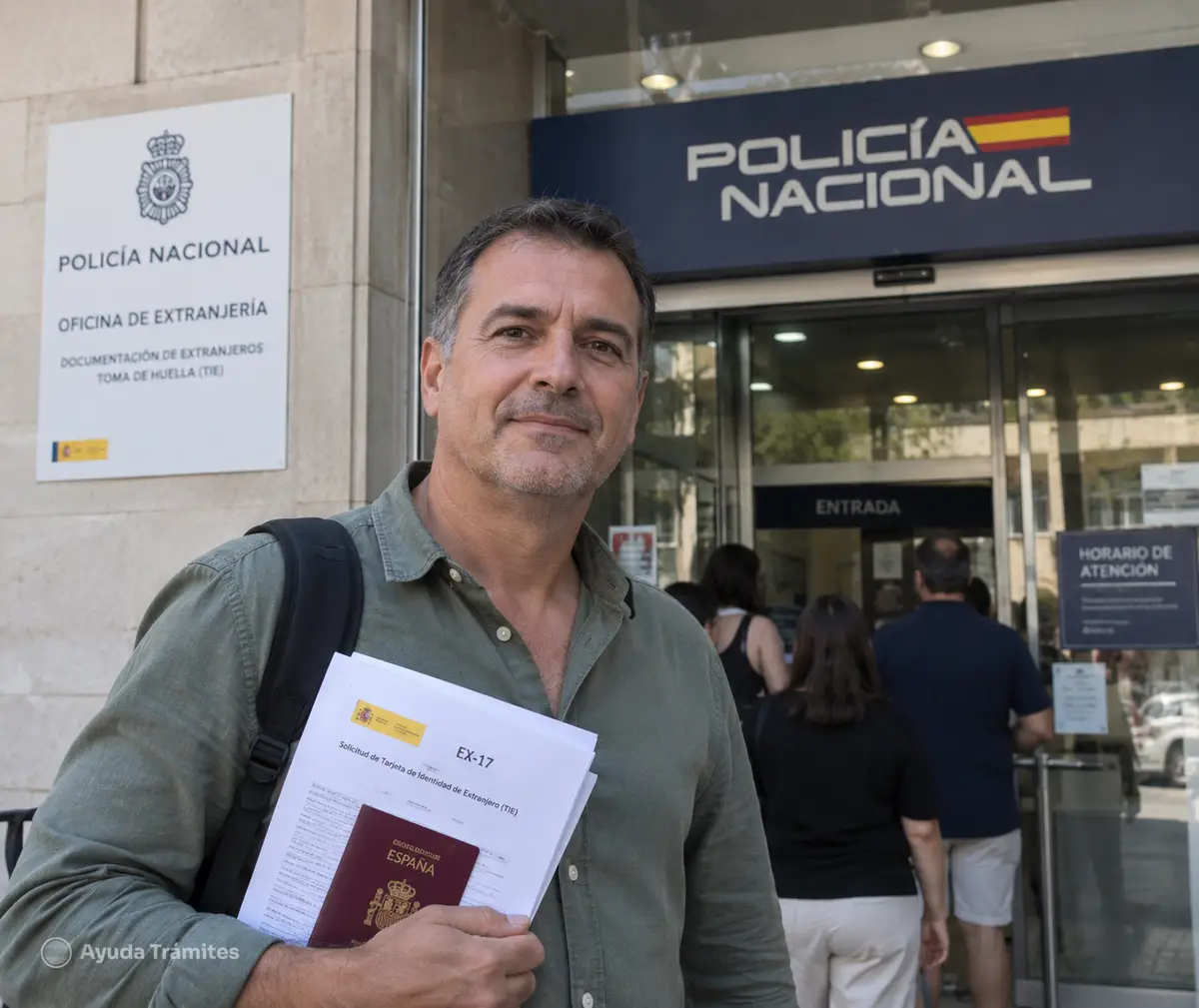
- Prepare the TIE. Complete form EX-17 and attend the appointment with your passport, decision, fee receipt and photograph. See our TIE application guide. The card is issued for the authorisation's validity period, which is one year.
- Check your Social Security. Your NUSS (Social Security number) was assigned automatically when your application was admitted. Your employer registers you when they hire you. If you are self-employed, you register yourself. See our Social Security number guide.
- Check your municipal registration. Register on the padrón (the municipal register) at your town hall if you have not done so. If you changed address, update it. See our municipal registration guide.
Validity and changing your authorisation
The authorisation lasts one year. It allows you to live and work as an employee or self-employed person throughout Spain. It gives you full rights from the date of the grant. Its effect goes back to the application date.
It cannot be renewed as the same authorisation. During the two months before it expires, ask to change to another authorisation under Article 191 of the Regulations. This can be residence and work as an employee or self-employed person. If you apply on time, the old authorisation continues until a decision is made. You can also apply during the three months after expiry, but a penalty may be possible.
Only if you cannot ask for a change can you get a one-year extension. You must show active job seeking. This means registration with the public employment service. You can instead provide an integration effort report from your autonomous community. With serious illness, disability or retirement age, the extension lasts four years. See our TIE renewal guide for the card.
Documents for the fingerprint appointment
Prepare these documents before going to the National Police. Also take proof that you withdrew from international protection, if this applies to you.
- Passport, to identify you.
- Favourable decision, to prove the grant.
- EX-17 form, to apply for the TIE.
- Receipt for fee 790 code 012, to prove payment.
- Recent photograph with a white background, for the card.
- Appointment receipt, to prove the booking.
- Withdrawal from international protection, if it applies.
If the decision is refused
When the application is refused, you automatically lose the provisional authorisation to work. No separate decision is needed. If you work as an employee, tell your employer immediately.
Read the end of the decision, called the appeal information. It says whether you can file an alzada or reposición administrative appeal, and where to file it. An administrative appeal must be filed within one month from the day after notification. A court appeal (recurso contencioso-administrativo) must be filed within two months. Against administrative silence, you can appeal at any time from the day after the silence occurs.
Ask for free guidance from organisations in the Register of Immigration Collaborators or from the legal aid service of the bar association. Their advice is free.
There are also five arraigo routes: second chance, work-based, social, training-based and family-based. Except for the family route, they require two years of continuous residence. See our arraigo guide. An earlier refusal of an arraigo application does not stop you filing a new one if you meet the requirements.
Three months, silence and provisional authorisation
The maximum time to decide and notify you is three months. It starts on the day after the application enters the register of the competent body. This period can be suspended, for example while you answer a document request.
If three months pass without notification, the application is treated as refused because of silencio administrativo (no answer within the legal deadline). This does not remove your provisional authorisation to live and work. It continues until an express decision, either favourable or refused. The silence only allows you to appeal if you want to. The administration must still make an express decision.
There is no official number of favourable or refused decisions. There is also no official average decision time. The interpretative guidance on provisional authorisation explains this situation.
Common problems and how to fix them
Admission letter hasn't arrived
Check infoext2 even without the letter. If the admission does not appear there, report the problem to the immigration service and include your case number.
Status has not changed
Applications are not always processed in strict order. Check the status and your notifications. Don't file another application for this reason.
I don't understand the request
Read each requested document and the deadline. If you don't understand it, ask a collaborating organisation or the legal aid service for free help.
The TIE deadline passed
Book an appointment as soon as possible and explain the delay. Take the decision and all available documents.
Your passport has expired
The application accepted an expired passport. For the TIE, ask at the appointment. Take proof that you asked your consulate or embassy to renew it.
Frequently asked questions
How do I check my regularisation status in Spain?
Use infoext2 with your NIE or your 15-character case number. You can also text NIE or EXPE, followed by the number, to 651 714 610. The result is for information only.
What does en trámite mean?
It means your application is registered and still under review. There is no decision yet. Keep checking your notifications while you wait.
What happens after three months with no answer?
The application may be treated as refused because of administrative silence. Your provisional authorisation to live and work still continues until an express decision. You can appeal if you choose.
When do I apply for the TIE after regularisation?
Book your fingerprint appointment within one month of the grant. Take the EX-17 form, decision, passport, photograph and receipt for fee 790 code 012.
Can I work while I wait for the decision?
If you received the start-of-procedure notice or admission for processing, you have provisional authorisation to live and work as an employee or self-employed person. It lasts until an express decision.
What if my regularisation is refused?
You lose the provisional authorisation to work. Read the appeal information at the end of the decision. It shows the possible appeal and deadline. You can also ask for free guidance.
Can I travel before I get the TIE?
The authorisation gives you full rights from the grant. However, you need documents to leave and re-enter Spain. It is safer to wait for the TIE or ask the National Police first.
How long does the permit last and what do I do when it expires?
It lasts one year. During the two months before expiry, ask to change to another authorisation. If you cannot change it, an extension may be available in the cases described above.
Official procedure
Official sources
These are the official sources for this guide:
- Real Decreto 316/2026, regularización extraordinaria, disposiciones adicionales 20.ª y 21.ª (BOE) www.boe.es
- Regularización extraordinaria: preguntas frecuentes y estado del proceso (Ministerio de Inclusión) www.inclusion.gob.es
- Información sobre el estado de tramitación de los expedientes de extranjería (sede de las Administraciones Públicas) sede.administracionespublicas.gob.es
- MERCURIO: aportación de documentación a expedientes de extranjería (sede de las Administraciones Públicas) sede.administracionespublicas.gob.es
- 100 preguntas técnicas sobre la regularización extraordinaria (Ministerio de Inclusión, PDF) www.inclusion.gob.es
- Criterio interpretativo sobre la vigencia de la habilitación provisional (Dirección General de Gestión Migratoria, PDF) www.inclusion.gob.es
- Balance del plazo de presentación: 1.174.978 solicitudes (La Moncloa, 2 de julio de 2026) www.lamoncloa.gob.es
- Afiliación de agosto de 2026: altas procedentes de la regularización (La Moncloa, 2 de septiembre de 2026) www.lamoncloa.gob.es
- Orden PJC/617/2025, importe de las tasas de extranjería (BOE) www.boe.es
- Tarjeta inicial o renovación de residencia o residencia y trabajo (Sede de la Policía Nacional) sede.policia.gob.es
- Ley 39/2015 del Procedimiento Administrativo Común: silencio, recursos de alzada y reposición (BOE) www.boe.es
- Ley 29/1998 de la Jurisdicción Contencioso-administrativa, plazo del recurso (BOE) www.boe.es
These links go to official websites. The procedure is free of charge.
Spotted something incorrect? Email us at info@ayudatramites.es.