Ayuda Trámites


The EX-26 form is how you move from your current Spanish residence permit to another without going back to your country, for example when the regularisation or arraigo year ends. The most important step is to tick a single box in section 5.
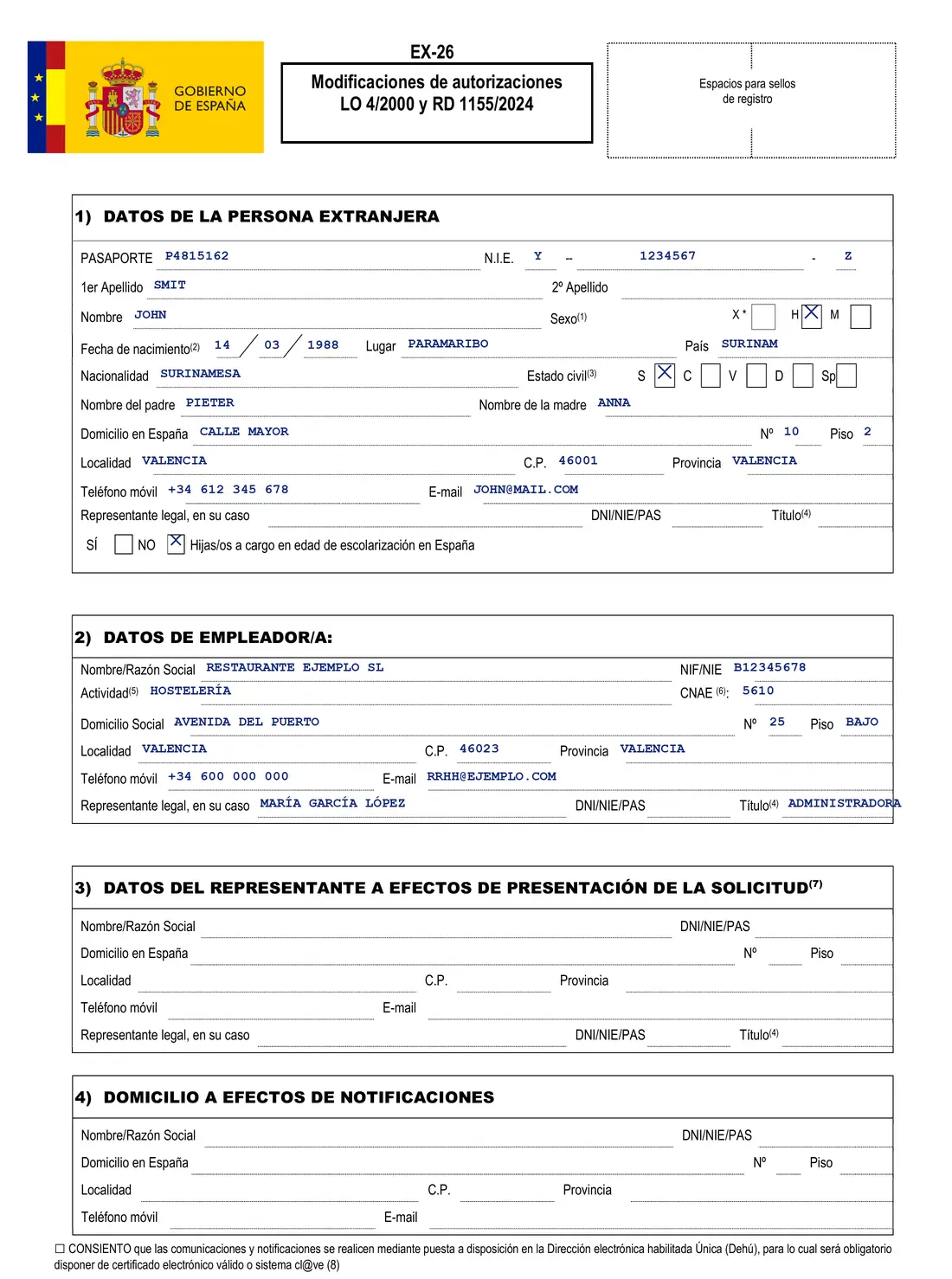
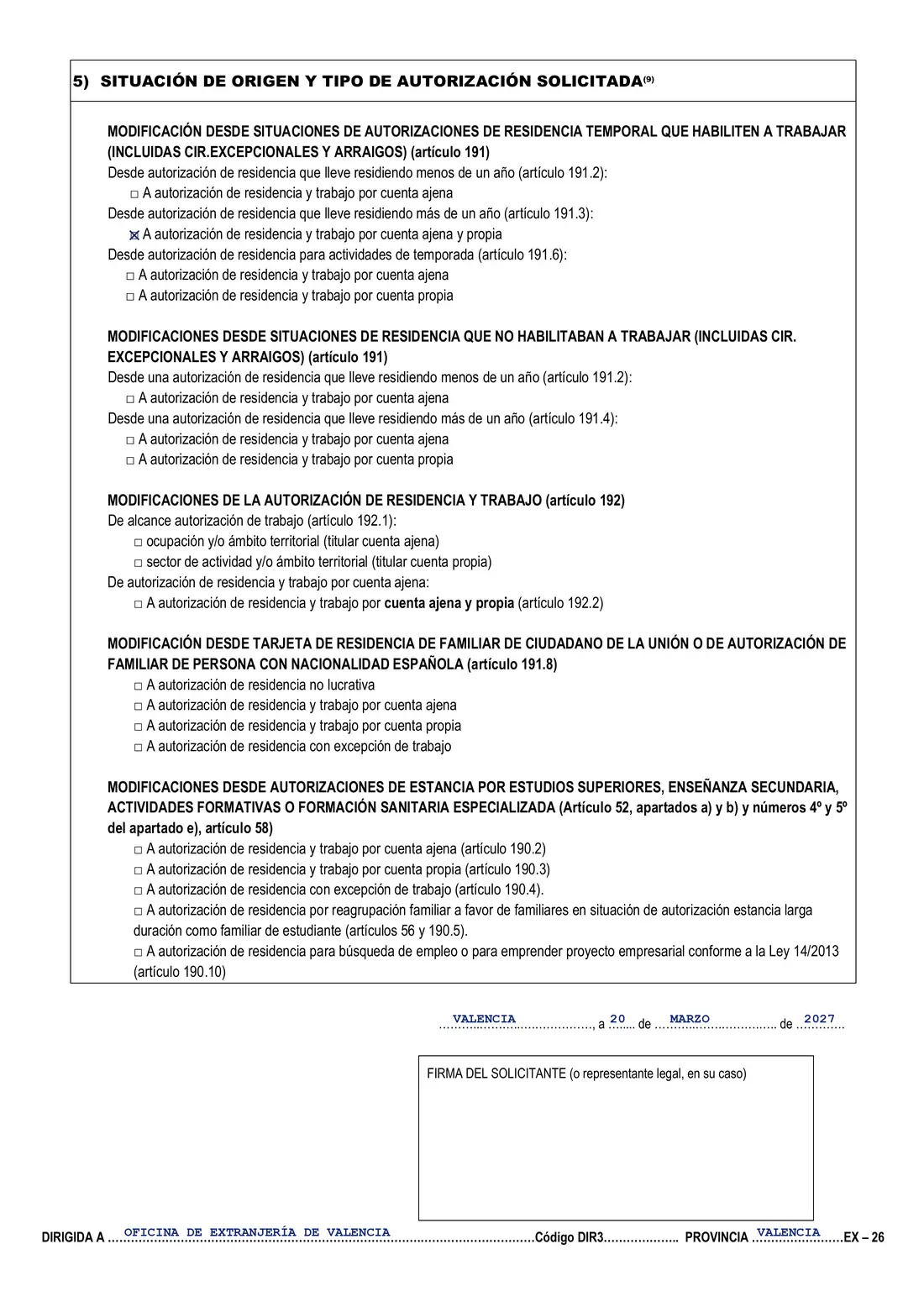
EX-26 form: interactive example
Move your mouse over a box to see what to fill in there and when. On a phone, tap the box. Use the buttons to switch between page 1 and page 2.
Which box to tick in section 5
The EX-26 form is for a modificación (modification): moving from one residence authorisation to another without a visa. It is not a renovación (renewal).
| Your situation | Box in section 5 | What you get |
|---|---|---|
| Regularisation or social, socio-labour or second-chance arraigo (residence based on ties to Spain), at least one year (the regularisation counts from the day you applied) | Artículo 191.3 («más de un año») | Work as an employee and self-employed, four years |
| The same permits, with less than one year | Artículo 191.2, first group | Employee work as a first permit, one year |
| A residence permit without work rights, such as non-lucrative, at least one year | Artículo 191.4 | Employee or self-employed work, one year |
| An EU or Spanish family member card that no longer applies, such as after a divorce | One of the four under artículo 191.8 | Non-lucrative, employee, self-employed or exempt from work permit |
| Study stay finished, with your qualification | Studies group (artículo 190) | Employee, self-employed or other options |
| Changing occupation, sector or area in the first year of a work permit | Artículo 192.1 | A different scope for your permit |
Download the EX-26 form
The EX-26, often written EX26, is the official form from Spain's Ministry of Inclusion. The PDF can be filled in: type on your computer, or print it and complete it by hand in CAPITALS with a black pen. You hand in the original and a copy. The form is free.
Download the EX-26 (official PDF)

How to fill in the EX-26, section by section
The form is in Spanish, so write your answers in Spanish too.
- 1) DATOS DE LA PERSONA EXTRANJERA (your details)
- As in your passport, with your NIE, the date as dd/mm/yyyy and the X for sex only if your country recognises it. Tick SÍ or NO for «Hijas/os a cargo en edad de escolarización en España» (dependent children of school age in Spain).
- 2) DATOS DE EMPLEADOR/A (employer)
- Only if you apply for employee work with an employer: name or company name, NIF/NIE, main activity (note 5) and CNAE code (note 6).
- 3) DATOS DEL REPRESENTANTE (representative)
- Only if someone other than you submits the application (note 7).
- 4) DOMICILIO A EFECTOS DE NOTIFICACIONES (address for notices)
- Where you want to receive notices; if left empty, they go to the applicant. Add a mobile or e-mail to get alerts.
- CONSIENTO (DEHú)
- Tick it only if you have a digital certificate or Cl@ve: notices will then arrive at the DEHú (note 8).
- 5) SITUACIÓN DE ORIGEN Y TIPO DE AUTORIZACIÓN SOLICITADA (current situation and permit requested)
- One box only (note 9), the one in your row of the table above.
- Place, date and signature
- You sign or, if you have one, your legal representative.
- DIRIGIDA A (addressed to)
- The Oficina de Extranjería (immigration office) of your province, its DIR3 code and the province. If you do not know the code, ask when you submit.
What happens when the regularisation permit expires
The extraordinary regularisation permit lasts one year and lasts one year. The usual next step is a modification under article 191 with the EX-26; only if you cannot apply for one is there the exceptional extension described below.
- When: in the two months before it expires. Your permit stays valid until they decide.
- Late: you can still apply up to three months after expiry, but you may face penalty proceedings.
- Box: your permit counts from the day you applied for the regularisation. If a full year has not passed when you submit the EX-26, first ask your Oficina de Extranjería which box they accept. With a year or more, article 191.3; with less, 191.2.
- If you do not meet the requirements: a one-year prórroga (extension) if you are looking for work and registered with the public employment service, or with an integration report from your regional government.
- Serious illness, disability or retirement age: the extension is for four years.
The same applies if you got the permit as an international protection applicant (disposición adicional 20.ª). Still waiting for the decision? Check the status of your application.
How to submit the EX-26
- Check the deadline and your box.
From the regularisation, in the two months before expiry. The box is in the table.
- Gather the documents.
Those on the information sheet (hoja informativa) for your case: a copy of your full passport, the contract or proof of your situation, and foreign documents translated by a sworn translator and legalised or apostilled.
- Submit the application.
At the Oficina de Extranjería of the province where you live, or online through Mercurio (the government's online filing system) with a digital certificate. Depending on the case, you or your employer submits it.
- Pay the fee.
The tasa (government fee) 790 052 costs 10,94 euros and you have ten working days to pay it. From a residence permit it is code 2.5.2 (2.5.1 from studies, 2.5.3 for article 192). If there is an employer, they also pay the tasa 062: from a permit that already let you work, code 3.2.2, 81,54 euros (information sheet 55); from one that did not, the first-permit code 3.2.1 (sheets 55 bis and 57). More in the tasa 790 052 guide.
- After approval.
According to sheet 55, you have one month from the notice to register with Social Security. In the following month you apply in person for the TIE (foreigner identity card) with the EX-17.

Do you need a lawyer?
A lot is at stake: if the modification is refused or comes too late, you are left without a permit and cannot work legally. An immigration lawyer is worth it if you have no contract, have been asked for more documents, have already been refused, your case mixes several situations or the deadline has passed. To appeal, see what to do after a refused application. In a simple case you can do it yourself: the form is free and you submit it yourself.
Want a lawyer to look at your case? We put you in touch with a registered lawyer in your province. Free and with no obligation.
Contact a lawyerCommon problems
I do not know if this is a renewal or a modification
If you change the type of permit, for example from arraigo or the regularisation to a residence and work permit, it is a modification with the EX-26. If you keep the same type, it is a renewal or, for arraigo, a one-year prórroga (extension) that requires you to look for work and register with the public employment service. For the card itself, see the guide to renewing your TIE.
I do not have a work contract
With at least one year (191.3) you do not always need one. Other options include a contributory unemployment benefit, nine months registered with Social Security in a twelve-month period, or a family member with the means to bring you over. If you can prove none of these, your integration effort is assessed with a report from your regional government.
My card has already expired
With the 191.3 box, the new permit runs from the day after the old one expired. Outside the three-month margin of the regularisation, talk to a professional before you submit anything.
My contract is part-time
With less than one year, your total pay must reach the full-time minimum wage over a year. With at least one year, it is enough to continue the employment that gave you the permit; a new contract must meet that same rule.
Frequently asked questions
Can I work while the application is processed?
From the regularisation, yes: if you apply in the two months before expiry or the three months after, your permit and its right to work stay valid until the decision.
How long does the EX-26 take?
Information sheet 55 gives three months; if you get no notice in that time, the application counts as refused by administrative silence. You can check your application in the meantime.
Can my employer submit it?
Yes, article 191.5 allows the employer or the foreign national to submit it. From a family member card, for non-lucrative residence or self-employment, sheet 57 says you must submit it yourself.
When does the new permit start?
Under article 191.3, from approval, or from the day after the old one expired if it already has. Under 191.4, only once you are registered with Social Security, within a month of the notice; it then counts from the day after the old permit expired.
Official procedure
Official sources
These are the official sources for this guide:
- Formulario EX-26: modificaciones de autorizaciones, LO 4/2000 y RD 1155/2024 (Ministerio de Inclusión, PDF rellenable) www.inclusion.gob.es
- Hoja informativa 55: modificación desde autorizaciones de residencia temporal que habilitan a trabajar, incluidas circunstancias excepcionales y arraigos (Ministerio de Inclusión) www.inclusion.gob.es
- Hoja informativa 55 bis: modificaciones desde situaciones de residencia que no habilitaban a trabajar (Ministerio de Inclusión) www.inclusion.gob.es
- Hoja informativa 57: modificación desde tarjeta de familiar de ciudadano de la Unión o autorización de familiar de persona española (Ministerio de Inclusión) www.inclusion.gob.es
- Reglamento de Extranjería, artículos 191 y 192: modificaciones de autorizaciones (RD 1155/2024, BOE) www.boe.es
- Real Decreto 316/2026, regularización extraordinaria, disposiciones adicionales 20.ª y 21.ª (BOE) www.boe.es
- Orden PJC/617/2025, tasas de extranjería (BOE) www.boe.es
- Tasa 052: tramitación de autorizaciones de residencia (sede del Ministerio de Política Territorial y Memoria Democrática) mptmd.sede.gob.es
- MERCURIO: aportación de documentación a expedientes de extranjería (sede de las Administraciones Públicas) mptmd.sede.gob.es
These links go to official websites. Booking an appointment is free; you only pay the official administrative fee (Modelo 790 Código 012).
Spotted something incorrect? Email us at info@ayudatramites.es.