 Ayuda Trámites
To get your first TIE card, fill in form EX-17, pay the 790 fee (code 012), book a fingerprint appointment (toma de huellas) at the National Police, and attend with your passport, photo, fee receipt and visa or resolution. Do this within one month of entering Spain or of your authorisation taking effect.
What the TIE actually is
The TIE (Tarjeta de Identidad de Extranjero) is the physical card that shows you have permission to live in Spain. It is not the permission itself. Your right to live and, where applicable, work in Spain comes from your visa or from the resolution that approved your authorisation. The TIE just documents that right on a card you can carry and show. Applying for the TIE does not give you any new rights: you already have them once your visa or resolution was approved.
Do not wait for the card to arrive before you rely on your approved status. Your rights start from the date set out in your visa or resolution, not from the day you collect the TIE.
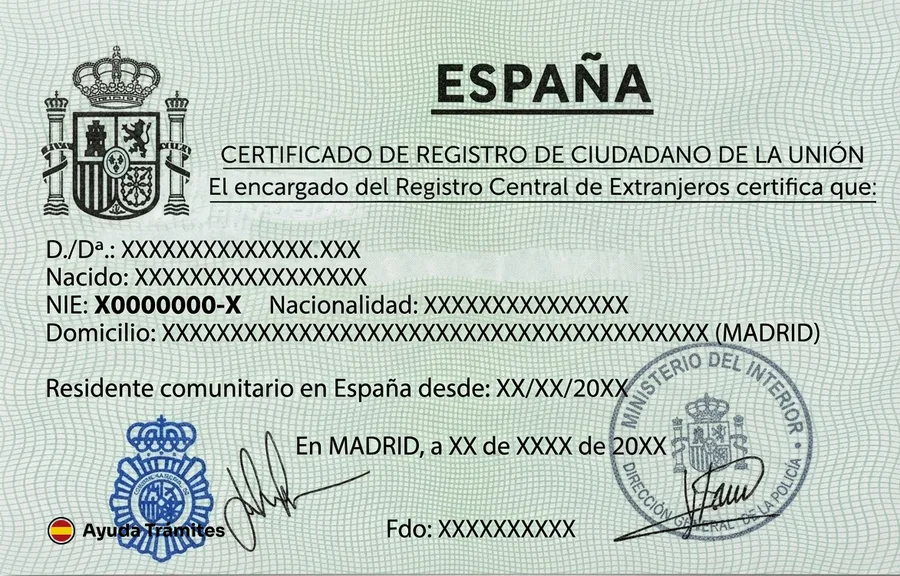
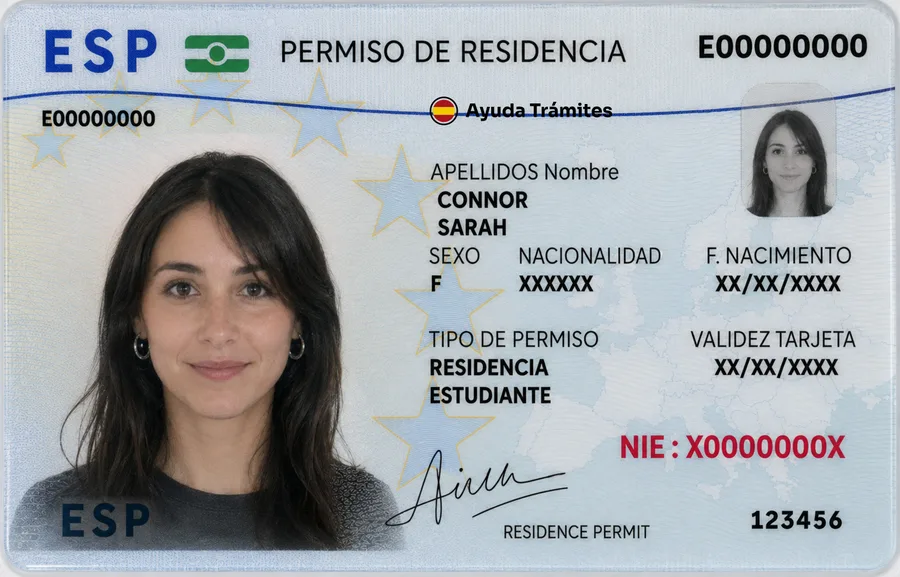
NIE and TIE: what is the difference
People often mix up these two terms. The NIE (Número de Identidad de Extranjero, a foreigner ID number) is just a number. It stays the same for as long as you are in the Spanish system. The TIE is the physical card, and your NIE number is printed on it. If you already have an NIE from an earlier step, you do not apply for a new one: the same number goes on your first TIE card. If you need more detail on how the NIE works, see our guide to the NIE number in Spain.
Before you start: check the one month deadline
In most cases you must apply for the TIE within one month of entering Spain, or within one month of your authorisation being granted or taking effect. This deadline is set by law, so start the process as soon as you can.
How to apply for your first TIE card
- Gather your paperwork. You will need your approved resolution or visa, your full passport, and proof of your address if it is requested (an empadronamiento certificate, a registration with your town hall). See our guide on empadronamiento in Spain if you have not done this yet.
- Fill in form EX-17. This is the official application form for the TIE card. Complete it fully and sign it. You can find the form on the National Police website.
- Pay the fee (Modelo 790, code 012). This fee covers your first card after an initial authorisation. In 2026 it is 16,08 euros, but always check the current amount on the official form before you pay, since fees change over time. Make sure you use code 012, not another code: this fee is paid to the Police, not to the immigration office.
- Book your fingerprint appointment (toma de huellas). You need an appointment at a National Police station to give your fingerprints and hand in your documents. The booking system is run through the national appointment portal. Our guide to booking an extranjería appointment in Spain walks you through the portal step by step. Dropdown option names can differ between provinces, so read the options carefully and pick the one that matches a TIE collection or fingerprint appointment for your case.
- Attend your appointment with all documents. Bring your passport, signed EX-17 form, fee payment proof, one recent passport-size photo with a white background, your visa or resolution, and your empadronamiento certificate if it was requested. The officer will take your fingerprints and give you a receipt (resguardo, a proof of application).
- Collect your card. The TIE is usually ready a few weeks after your appointment. You will need your resguardo and your passport to collect it, usually at the same police station.

Documents checklist
When you go to your appointment to apply for the TIE, these are the documents to take with you. Bring the original of each one plus a photocopy.
- Full valid passport, to prove your identity
- Completed and signed EX-17 form, the official TIE application
- Proof of payment of the 790 fee, code 012
- One recent passport-size photo with a white background
- Your visa or the resolution that approved your authorisation
- Empadronamiento certificate, where your police station asks for it
- The resguardo receipt from your fingerprint appointment, needed to collect the card
Common problems and how to fix them
No fingerprint appointments available
Appointment slots for the National Police fill up fast and new ones can appear at any time of day. Keep checking the appointment portal at different times, including early morning. If your province has more than one police station handling extranjería, try each of them, since availability can vary a lot between stations. Booking an appointment is always free: never pay anyone who offers to get you one faster.
Your photo gets rejected
Photo rules for official documents are strict: plain white background, no glasses, no shadows, forward facing. If your photo is rejected, get a new one from a photo booth or shop that knows the requirements for Spanish official documents, and ask them to confirm it meets the standard size and background.
You paid the fee with the wrong code
Code 012 is for the National Police and covers your TIE card. Code 052 belongs to the immigration offices (Oficinas de Extranjería) and covers different procedures, such as some residence authorisation applications. If you paid the wrong code, you will need to correct this before your appointment. Check our guide to renewing your TIE in Spain for more on how the fee system works across procedures.
Your card is taking longer than expected
Processing times vary by province and by how busy the police station is. If it has been much longer than a few weeks since your appointment, contact the police station where you applied and ask for an update, using your resguardo receipt as reference. Do not apply again: one application is enough, and a second one could cause confusion.
Next steps
Once you have your TIE, keep it with you at all times along with your passport, since you may be asked to show it. If your authorisation is later renewed, you will go through a similar process again: our guide to renewing your TIE in Spain explains what changes for a renewal.
Frequently asked questions
How long does it take to get the TIE card after the appointment?
It usually takes a few weeks after your fingerprint appointment, but times vary by province and by how busy the police station is. You will get a resguardo receipt at your appointment: keep it, since you need it to collect the card and to check on its progress if it takes longer than expected.
Can I travel outside Spain while I am waiting for my TIE?
This depends on your situation, since the TIE itself does not give you your rights, your visa or resolution does. If you need to travel before you have your card, ask about an autorización de regreso (a return authorisation) at your police station or immigration office, so you can come back into Spain without problems.
Can I work while I am waiting for my TIE card to arrive?
Whether you can work depends on the authorisation you were granted, not on whether you already hold the physical card. If your resolution or visa allows you to work, that right applies from the date it was approved. Check the wording of your own resolution or visa, or ask at your immigration office, if you are not sure.
What happens if I miss the one month deadline to apply for the TIE?
You should still apply as soon as possible. Rules and any consequences for a late application can depend on your specific case, so if you have missed the one month deadline, contact your nearest immigration office or police station for guidance rather than waiting any longer.
Do I need a new NIE number for my TIE card?
No. If you already have an NIE number, it stays the same and is printed on your new TIE card. The TIE application is about getting the physical card, not about getting a new number. See our NIE number guide for more on how the number works.
Where do I book my fingerprint appointment for the TIE?
Fingerprint appointments (toma de huellas) are booked through the national appointment portal used for extranjería procedures. Our guide to booking an extranjería appointment in Spain explains the portal step by step, including what to do when no slots are showing.
Official procedure
Official sources
These are the official sources for this guide:
- Tarjeta inicial o renovación de residencia o residencia y trabajo (Sede de la Policía Nacional) sede.policia.gob.es
- Tarjeta de identidad de extranjero (Ministerio del Interior) www.interior.gob.es
- Tasas de trámites de extranjería (Sede de la Policía Nacional) sede.policia.gob.es
- Cita previa de extranjería, portal ICP (administracionelectronica.gob.es) icp.administracionelectronica.gob.es
These links go to official websites. The procedure is free of charge.
Spotted something incorrect? Email us at info@ayudatramites.es.