 Ayuda Trámites
The right way to get your foreigner identity number (NIE) depends on your nationality and your reason for needing it. This guide shows you the correct route: registering as an EU resident, applying for the TIE card as a non-EU citizen, or requesting a standalone NIE certificate for specific paperwork.
Which NIE route do you need?
NIE means your foreigner identity number in Spain. It identifies you for administration, but it does not give residence or work rights.
Choose your route
- EU registration certificate, EX-18: for EU, EEA or Swiss citizens moving to Spain for more than 3 months.
- TIE card, EX-17: for non-EU citizens with residence authorisation.
- Standalone NIE certificate, EX-15: for specific paperwork only, such as buying property.
Route 1: EU, EEA or Swiss citizens and form EX-18
This is the correct route if you are an EU, EEA or Swiss citizen planning to live, work, study or settle in Spain for more than three months. You must register in the Central Register of Foreigners (Registro Central de Extranjeros) within three months of your arrival.
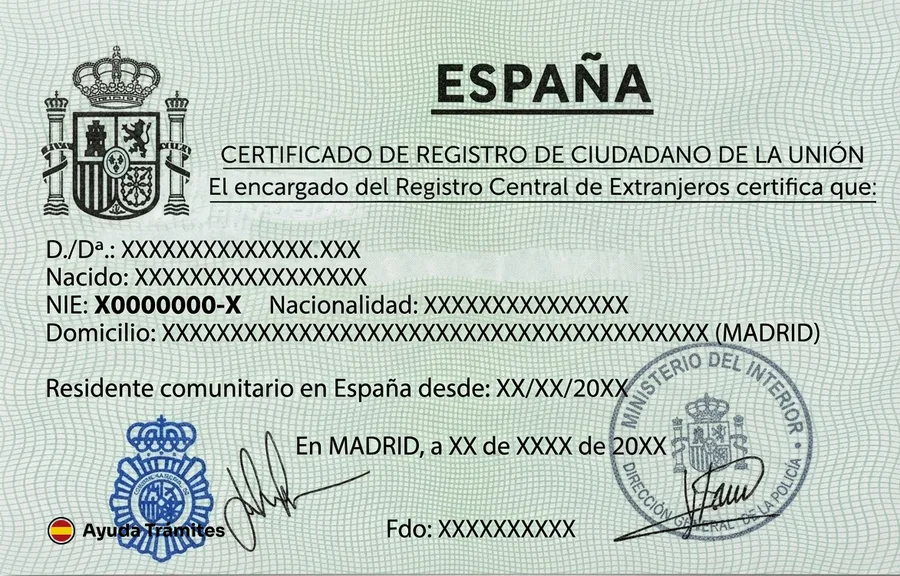
For EU, EEA and Swiss citizens, this is not technically a residence permit. You are registering as an EU resident in Spain. The result is the green EU registration certificate, commonly called the green NIE, with your NIE printed on it. It is a paper certificate, not an ID card, and it does not expire.
The process starts with booking a cita previa, the official appointment for your NIE or EU registration procedure. This is often the most stressful step because available slots can be hard to find. After that, you submit form EX-18 and prove that you meet the residence conditions.
If everything is correct, you'll receive your green EU registration certificate on the spot, which will have your new foreigner identity number printed on it.
- Form
- EX-18
- Fee
- 12,00 € (Modelo 790, code 012)
- Typical timeline
- The certificate is issued on the spot, at the appointment itself
- You get
- The green EU registration certificate with your NIE
Official forms Checked: July 2026
Checklist EX-18
The documents to bring to your EU registration appointment with form EX-18.
- Completed form EX-18, printed in duplicate. Download a fresh version from official government websites before your appointment.
- Original passport or national ID plus a photocopy.
- Proof of your situation in Spain. Employee: employment contract, employer certificate or Social Security registration. Self-employed: Agencia Tributaria or Social Security registration. Not working: proof of sufficient funds and full health insurance cover in Spain. Student: enrolment, health insurance and proof of sufficient funds. Family member: family relationship documents and proof that the EU citizen qualifies.
- Empadronamiento certificate if you have it. It is not always listed as mandatory everywhere, but it is often requested in practice, especially when your Spanish address matters or has changed, so bring it if you have it.
- Appointment confirmation for the extranjería office or National Police station.
- Modelo 790 Código 012 payment receipt.
- Originals and copies of everything.
How to fill in form EX-18 without getting sent away
- Use capital letters throughout the form.
- Use black pen and clear block letters, or fill it in digitally and print it.
- Print two copies.
- Download a fresh version from the official government website before your appointment.
- If you already have a NIE, fill it in. If you never had one, leave the NIE field blank.
- Write dates in the Spanish format, dd/mm/yyyy.
- Use your actual arrival date in Spain as the start date, not the appointment date.
- For Domicilio en España, use your real Spanish address and make sure it matches the documents you bring.
- Leave the representative section blank unless a lawyer, gestor or authorised representative is actually submitting the form for you.
- Do not tick electronic notifications unless you understand Dehú, have a digital certificate or Cl@ve access, and will check official notifications.
Requirements can vary slightly by province or police station, so always check the instructions for your specific appointment.
I want to live or work in Spain for more than 3 months
Use this if you are moving to Spain to take up a job, start a business, or settle here for the long term. This is the standard procedure for EU, EEA and Swiss citizens becoming residents. You must register within three months of arriving by following the full EX-18 process described above.
If you are going to work in Spain, arrange your Spanish Social Security number and registration before you start work. If you are not going to work, for example as a student or non-active resident, this step may not apply.
Avoid this mistake: Don't use form EX-15 for a standalone NIE if your actual plan is to live and work here, as you'll only have to do more paperwork later to get your required EU registration certificate.

I only need a NIE for paperwork, not residency
Use this if you are not moving to Spain yet but need a foreigner identity number for a single transaction, like buying a holiday home or dealing with an inheritance. In this case, the standalone NIE route using form EX-15 might be a better fit than registering as a resident. You can find the full details in the standalone NIE route section.
Avoid this mistake: Don't get a standalone NIE and then assume it allows you to live in Spain, as it provides no residence rights and you'll still need to register correctly with form EX-18 if you later decide to move.
I already live in Spain but never registered
Use this if you've been living in Spain for more than three months but haven't completed your registration as an EU resident. You should regularise your situation as soon as possible. The procedure is the same: get an appointment and use form EX-18, bringing all the documents to prove you meet the residence conditions (work, sufficient funds, etc.).
Avoid this mistake: Don't try to get a standalone NIE with form EX-15 to solve this, as your situation is one of residence, and the authorities will expect you to complete the correct EU registration process.
I am not sure yet
Use this simple rule to decide. If you're just staying temporarily and have no specific Spanish administrative tasks to complete, you might not need a NIE yet. If you are planning to settle, work or study for more than three months, you need to register as a resident with form EX-18. If you only need the number for one specific task without moving here, the standalone NIE with form EX-15 is the way to go.
Avoid this mistake: Don't postpone the decision if you are already working or living here, as you are legally required to register within three months of arrival.
Route 2: Non-EU citizens, form EX-17 and the TIE card
This is the route for non-EU citizens who have, or are in the process of getting, authorisation to live, work or study in Spain. Your foreigner identity number is assigned as part of your residence or visa process.
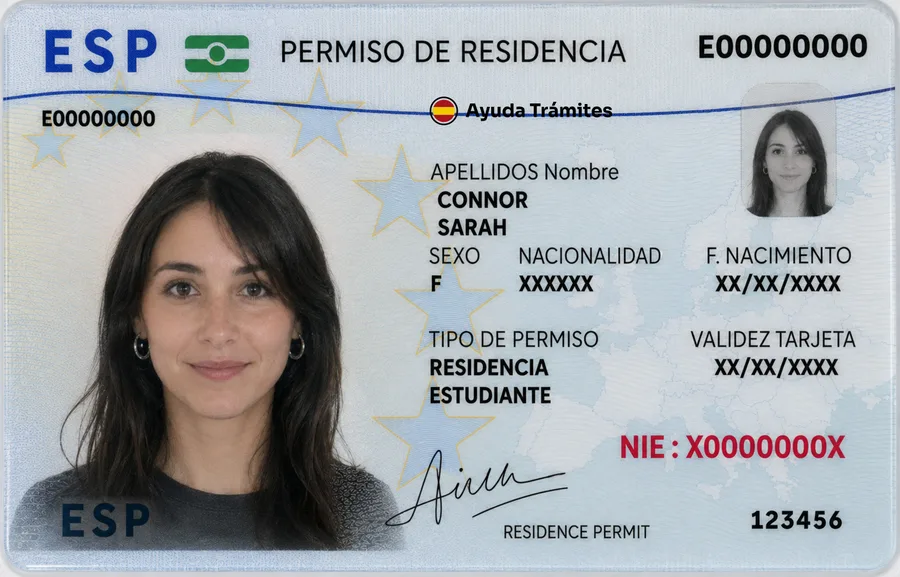
Once you have your authorisation, you must apply for your Foreigner's Identity Card (Tarjeta de Identidad de Extranjero or TIE). The TIE is the physical card that proves your legal right to be in Spain, and it will have your NIE printed on it. You must apply for your TIE at a National Police station within one month of entering Spain or of your residence authorisation being granted.
- Form
- EX-17
- Fee
- 16,08 € (Modelo 790, code 012)
- Typical timeline
- The card is usually ready a few weeks after your fingerprint appointment
- You get
- The TIE card with your NIE printed on it
Official forms Checked: July 2026
Checklist EX-17
The documents to bring to your TIE appointment with form EX-17.
- Valid passport and a copy of the main page.
- Your visa or the favourable resolution (the official letter) granting your residence or work authorisation.
- Completed form EX-17, available on official government websites.
- Proof of payment for the TIE card fee (Modelo 790 Código 012).
- A recent, passport-size colour photograph with a plain white background.
- Proof of local address registration (certificado de empadronamiento), if required by the local office. You can learn more about how to get your empadronamiento in our guide.
- Any other specific documents required for your type of residence.
I already have a visa or authorisation
Use this if you've arrived in Spain with a valid residence visa or have received a favourable decision on your residence application. This is the most common case: book your appointment and follow the full EX-17 procedure described above to get your TIE card.
Avoid this mistake: Don't miss the deadline, as you must apply for your TIE card within one month of your arrival in Spain or of your authorisation being approved.
I am applying after arriving in Spain
Use this if you are in Spain and need to apply for residence authorisation. Applying for a TIE with form EX-17 is not your first step. You must first secure the correct visa, work permit or residence authorisation. Only after that authorisation is approved can you proceed with the TIE application.
Avoid this mistake: Never assume that applying for a NIE or a TIE by itself grants you the right to live or work in Spain, as the authorisation must always come first from the immigration office (extranjería).
I need to renew or replace my TIE
Use this if your TIE card is expiring, lost or stolen. Your NIE number is permanent and never changes, so you don't apply for a new NIE. Instead, you apply to renew or replace your TIE card. The process and documents needed will depend on your residence type and the reason for the replacement. For full details, see our guide on the TIE card in Spain.
Avoid this mistake: Don't let your card expire before starting the renewal process for your underlying residence authorisation, as this can create serious administrative problems.
I only need a NIE for paperwork
Use this if you are a non-EU citizen not applying for residence but needing a NIE for a specific economic, professional or social reason in Spain, such as buying a property. In this situation, you should use form EX-15. You can find the full instructions in the standalone NIE route section.
Avoid this mistake: Don't rely on a standalone NIE if what you actually need is permission to live and work in Spain, as the EX-15 certificate provides no residence or work rights whatsoever.
Route 3: Standalone NIE number with form EX-15
This route is only for people who need a foreigner identity number for a specific, justifiable reason but are not becoming residents in Spain. The EX-15 form gives you a certificate with your NIE number, but it does not grant you any right to live or work in the country. It is purely for administrative identification.
Remember, this is not the standard route for people moving to Spain to live or work.
- Form
- EX-15
- Fee
- 9,84 € (Modelo 790, code 012)
- Typical timeline
- Up to 5 working days in Spain; consulate applications can take weeks
- You get
- A certificate with your standalone NIE
Official forms Checked: July 2026
- Book an appointment. You'll need a cita previa (prior appointment) at an extranjería office or National Police station. If you are outside Spain, you can apply at a Spanish Consulate.
Make a cita previa (appointment) - Fill in form EX-15. Complete the "Solicitud de Número de Identidad de Extranjero (NIE) y Certificados" form.
- Pay the fee. You need to pay the administrative fee using Modelo 790 Código 012 before your appointment.
- Prepare your documents. Gather your passport, copies, the form, proof of payment, and the document that proves why you need the NIE.
- Attend the appointment. Submit all your documents in person.
- Receive your NIE certificate. If everything is correct, you'll be told when to collect your NIE certificate, or it may be issued on the spot. The official resolution time is five working days.

Checklist EX-15
The documents to bring to your appointment for a standalone NIE with form EX-15.
- Valid passport or national ID document and a complete copy.
- Completed and signed form EX-15.
- Proof of payment of the corresponding fee using form Modelo 790 Código 012.
- A document or letter explaining the reason why you need the NIE (economic, professional or social). This is very important.
- Appointment confirmation printout.
- Originals and copies of all documents submitted.
EX-15 · Solicitud de Número de Identidad de Extranjero (NIE) y Certificados
1) Datos del extranjero (your details)
4) Motivo de la solicitud (reason for the request) 4
The fields that raise the most questions
- Copy your valid passport number exactly as printed. Never leave this empty: it identifies the whole application.
- The Spanish form expects two surnames. If your country uses one, put it under "1er Apellido" and leave the second blank.
- If you do not live in Spain, give a contact address for notifications here (your lawyer's or notary's, for example) and fill in your foreign address in the dedicated section.
- The reason must be concrete and must match the supporting document you bring: write for example "Compra de vivienda en Alicante, contrato de reserva adjunto", not "personal reasons".
Every detail in this example is made up. Download the current official form with the button above and fill it in with your own details.
Buying property
Use this if you are purchasing a property in Spain. The reason must be concrete and demonstrable. For proof, you can provide a reservation contract (contrato de arras), a purchase agreement, a letter from your lawyer or notary, or other official real estate documentation that shows the transaction is in progress.
Avoid this mistake: Don't just state you are 'looking' for property, as a vague intention is often not accepted as sufficient proof.
Starting a company
Use this if you are in the process of setting up a business in Spain. You'll need documents that prove your business intentions are serious. This could include paperwork from your lawyer or gestoría, notary documents, or official drafts related to the company's formation.
Avoid this mistake: Don't simply present a business plan, as officials usually require proof that a formal administrative or legal process has already started.
Tax or inheritance procedure
Use this if you need a NIE to deal with taxes or an inheritance in Spain. The proof should be the official document that requires you to have a NIE. This could be a communication from the Spanish tax agency (Agencia Tributaria), official inheritance documents, a request from a notary, or a letter from your lawyer handling the case.
Avoid this mistake: Make sure the document clearly states that a Spanish identification number is required for the procedure to continue.
Bank, notary or administrative appointment
Use this for other specific administrative needs. Be aware that simply wanting to open a bank account may be considered too weak a reason on its own, unless it is clearly linked to another major transaction like buying a property. A letter from a notary, a lawyer, or an official administrative body requesting your NIE is much stronger proof.
Avoid this mistake: Don't rely on a generic email from a bank, as a formal letter explaining why the NIE is essential for a specific, named procedure is more likely to be accepted.
What a NIE is, and what it is not
These are easy to mix up, so here is the difference:
- The NIE (Número de Identidad de Extranjero) is just a number. It's your unique identification number for all official administrative and tax purposes in Spain. It does not, by itself, grant you the right to live or work here.
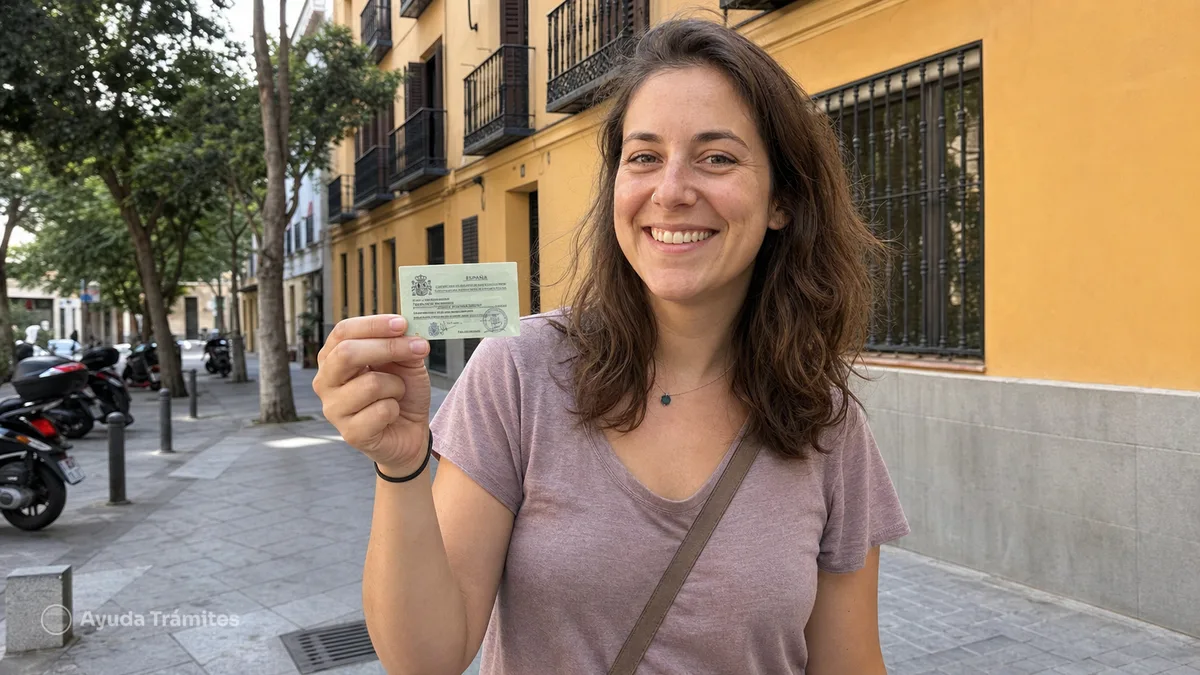
- The green EU registration certificate is a paper document for EU, EEA and Swiss citizens who register as residents for more than three months. It proves your right to reside in Spain and has your NIE printed on it. It is not an ID card.
- The TIE (Tarjeta de Identidad de Extranjero) is a physical, biometric ID card for non-EU citizens with authorisation to stay in Spain for more than six months. It proves your legal residence status and also has your NIE printed on it. The TIE is not the permit itself, it is the card that proves you have the permit.
A NIE is essential for almost any formal activity in Spain, from paying taxes and buying property to getting a job or signing up for utilities. However, the NIE number alone is not enough, you always need the corresponding residence and work authorisation if you plan to live and work here.
How to pay the Modelo 790 Código 012 fee
The fee for all these procedures is paid using form Modelo 790 Código 012 (2026 amounts, which item to choose and the steps are in our tasa 790 012 guide). You can fill it in online, print it, and take it to a bank to pay. Officially, you don't need a Spanish bank account, you can pay in cash at any collaborating bank, savings bank or credit cooperative.
In practice, this can be tricky. Some bank branches only accept these payments during limited morning hours (e.g., 8:30 to 10:30). Some staff may be unwilling to help non-customers, and some ATMs that allow payments require a Spanish bank card. Here are a few tips:
- Go early in the morning and try more than one bank.
- Ask a friend or contact with a Spanish bank account if they can help you pay it online or at an ATM.
- If you are applying through a Spanish Consulate abroad, always follow their specific payment instructions, as they can be different.
- Always check the current fee amount on the official form before paying, as the rates can change.
Common problems and how to solve them
- No cita previa available: This is one of the biggest stress points in the NIE and EU registration process. Appointment slots can disappear quickly and many people do not get one on the first try. Check the official booking system repeatedly, try early in the morning, try different police stations if possible, and start as soon as you arrive in Spain. Booking the appointment itself is free; the only official cost is the administrative fee.
- Choosing the wrong route: Many people apply for a standalone NIE with form EX-15 when they actually need to register as an EU resident (EX-18) or get a TIE (EX-17). Make sure you choose the route that matches your real situation.
- Wrong EX-18 category selected: If you tick employee, self-employed, student or non-active incorrectly, the office may ask for the wrong supporting documents or refuse the application. Choose the category that matches your real situation on the appointment date.
- Outdated form: Do not reuse an old EX-18 PDF saved years ago. Download the current version before your appointment.
- Only bringing originals: Bring photocopies too. Many offices will not copy documents for you.
- Address mismatch: If your form, padrón, appointment data and supporting documents show different addresses, this can create problems. Use one consistent Spanish address wherever possible.
- A weak reason for a standalone NIE: For an EX-15 application, your reason must be well-documented. A vague statement like "for business" is likely to be rejected.
- Problems paying the fee: As explained in how to pay the Modelo 790 fee above, paying at the bank can be a challenge. Be prepared to be patient and try different options.
- Missing copies or documents: Always bring the original and at least one photocopy of every single document.
- Confusion between NIE, TIE and the EU certificate: Understand the difference before you start to avoid applying for the wrong thing.
- The language barrier: Staff at the appointment will speak Spanish. If you don't, consider bringing a Spanish-speaking friend or a professional interpreter.
What to do after you get your NIE
Once you have your NIE number (either on a standalone certificate, an EU registration certificate, or a TIE card), you can move on to other essential steps for living and working in Spain. Depending on your situation, your next steps might include:
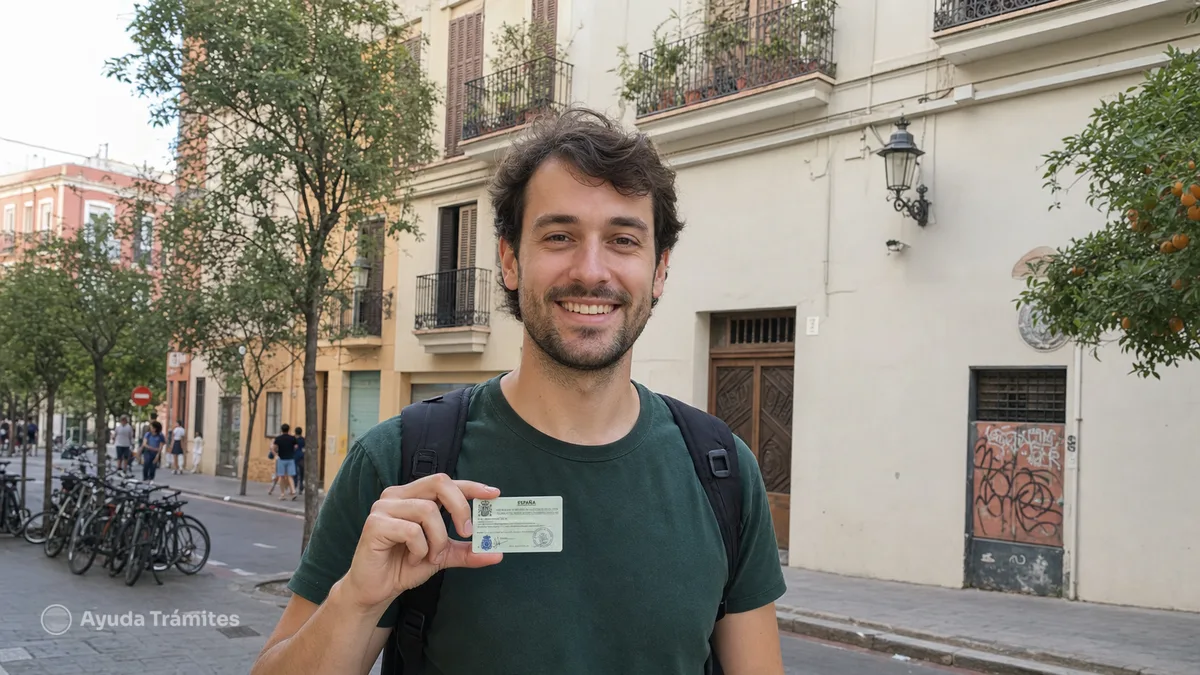
- If you got the green EU certificate, keep it safe. It is not an ID card, but it proves your EU registration and contains your NIE.
- If you plan to work, make sure your Social Security situation is arranged.
- Register or update your empadronamiento if your address is not yet correctly registered.
- If you are a non-EU citizen, collect your physical TIE card if you have not already.
- Use your NIE for tax, work, banking, utilities and other formal procedures.
- If you are looking for work, register as a jobseeker with the regional employment service.
- After five continuous years of legal residence, check whether permanent EU residence applies to you.
Remember, the official procedure to get a NIE is personal and inexpensive, costing only the official administrative fee. You are not required to pay for an intermediary or gestoría, though you can choose to hire one for convenience.
Frequently asked questions
Is a Spanish NIE the same as an e-number?
Yes, they refer to the same thing, but the official Spanish term is NIE, which stands for Número de Identidad de Extranjero. Some English speakers search for 'e-number' or 'foreigner number', but in Spain and on all official forms, it is always called the NIE.
What is the difference between a NIE and a TIE?
The NIE is the identification number itself, a sequence of letters and digits that never changes. The TIE (Tarjeta de Identidad de Extranjero) is the physical, biometric card that non-EU citizens with residence authorisation must carry. The TIE card displays your photo, personal details, type of residence permit, and your NIE number.
Can I work in Spain with just a NIE number?
No, you cannot. A NIE number is only an identification number for administrative and tax purposes. To work legally in Spain, you must have the appropriate work authorisation. For EU citizens, this is granted by their EU citizenship and confirmed with the EU registration certificate. For non-EU citizens, it requires a specific work visa or residence permit, which is then documented on their TIE card.
How long does it take to get a NIE number?
If you apply in person in Spain at a police station, the official resolution time for a standalone NIE (form EX-15) is five working days. For EU citizens registering as residents (form EX-18), the green certificate with the NIE is usually issued on the spot during the appointment. If you apply through a Spanish Consulate abroad, the process can take longer, sometimes several weeks, depending on the consulate's workload.
Do I need a lawyer or a 'gestoría' to get a NIE?
No, it's not mandatory. The process is designed to be done by the individual and only costs the official administrative fee. However, if you find the bureaucracy difficult, don't speak Spanish, or simply prefer to have someone handle it for you, you can hire a professional like a lawyer or a 'gestoría' (an administrative services agency). This is an optional, paid service.
Can I get permanent EU residence?
After five continuous years of legal residence in Spain, EU, EEA and Swiss citizens may apply for permanent residence. This is different from your first EX-18 registration. If you are applying for the first time, you normally choose temporary residence, not permanent residence.
Official procedure
Official sources
These are the official sources for this guide:
- Asignación de NIE a instancia del interesado (Sede de la Policía Nacional) sede.policia.gob.es
- Certificado de Registro de Ciudadano de la Unión Europea (Sede de la Policía Nacional) sede.policia.gob.es
- Tarjeta inicial o renovación de residencia o residencia y trabajo (Sede de la Policía Nacional) sede.policia.gob.es
- Tasas de trámites de extranjería (Sede de la Policía Nacional) sede.policia.gob.es
- Cita previa de extranjería (sede de las Administraciones Públicas) sede.administracionespublicas.gob.es
- Obtención de la residencia (administracion.gob.es) administracion.gob.es
- Certificate of registration as an EU national, the green NIE (Barcelona International Welcome, Ajuntament de Barcelona) www.barcelona.cat
These links go to official websites. Booking an appointment is free; you only pay the official administrative fee (Modelo 790 Código 012).
Spotted something incorrect? Email us at info@ayudatramites.es.