Ayuda Trámites


The EX-18 is the form to register as an EU citizen if you stay in Spain over three months. Fill it in using capitals and hand it in yourself with the tasa 790 012: you get the certificate with your NIE.
EX-18 form: interactive example
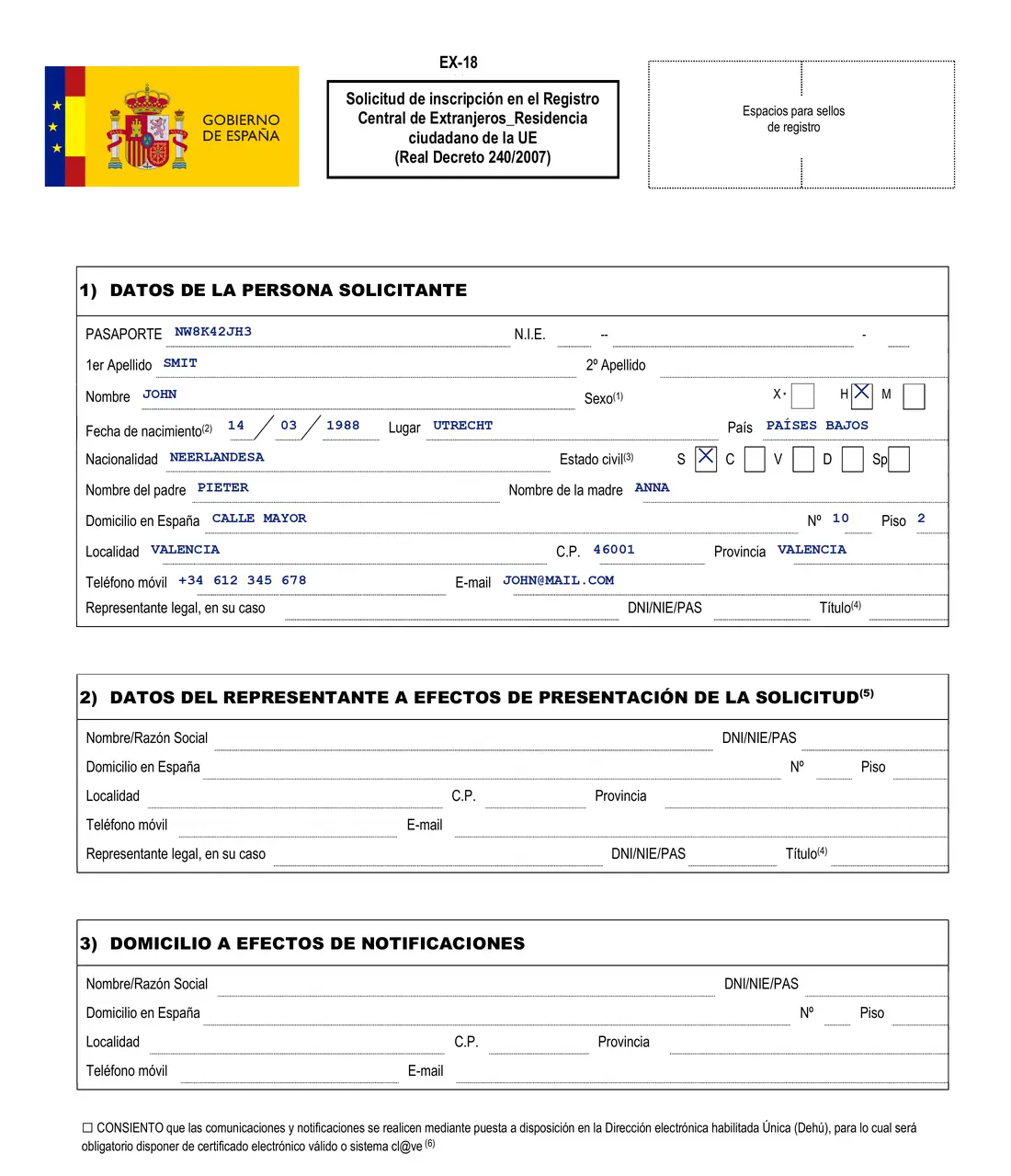
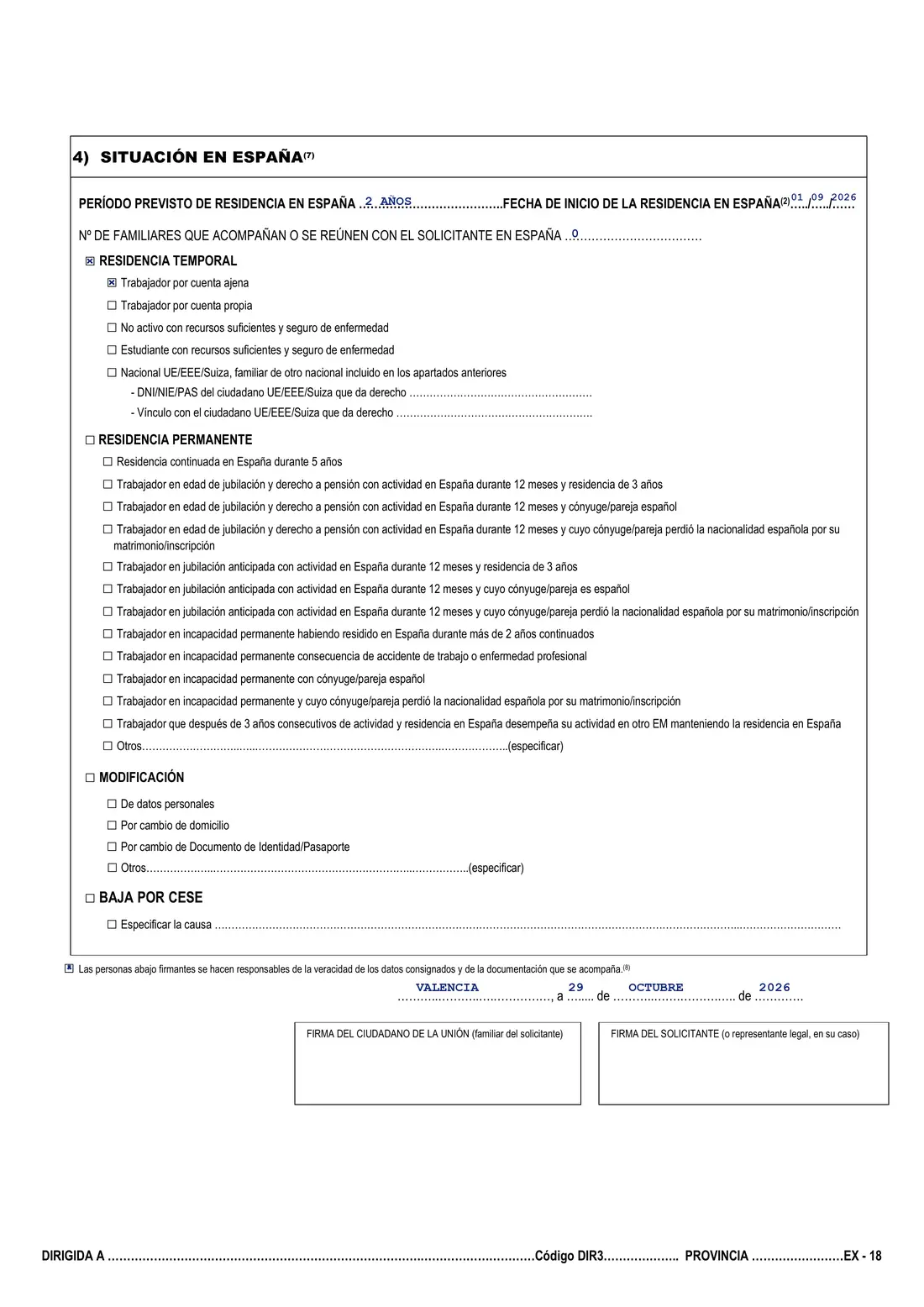
Move your mouse over a box to see what to fill in there and when. On a phone, tap the box. Use the buttons to switch between page 1 and page 2.
What is the EX-18 and who uses it
The EX-18 form registers you in the Registro Central de Extranjeros (Central Register of Foreign Nationals): you get the EU registration certificate with your NIE, often called the green NIE certificate. It is for citizens of the EU, the EEA and Switzerland staying more than three months, and also to update your details or deregister.
From outside the EU, you apply for the TIE with the EX-17; a non-EU family member uses the EX-19 for the EU family member card; for a NIE without living here, the EX-15. Moving for good? Start with the moving to Spain checklist.

Download the EX-18
The EX18 form, as it is also written, comes from Spain's Ministry of Inclusion (version 03). It cannot be filled in on a computer: print it and complete it in CAPITALS, with a black pen and block letters, or typed. You hand in an original and a copy. The form is free.
Download the EX-18 (official PDF)
How to fill in the EX-18, box by box
The form is in Spanish, so write your answers in Spanish too.
- 1) Datos de la persona solicitante (applicant)
- As in your passport or ID card: PASAPORTE (passport number), names, dates as dd/mm/yyyy, X for sex only if your country recognises it and marital status S, C, V, D or Sp. Domicilio en España is your address in Spain. With no NIE yet, leave that box blank.
- 2) Representative
- Only if someone else submits the application; registration is in person, so check first whether the office accepts this.
- 3) Address for notifications
- Where notifications should go; if blank, they go to the applicant. Tick CONSIENTO (DEHú, the online notification inbox) only if you have a digital certificate or Cl@ve.
- 4) SITUACIÓN EN ESPAÑA (status in Spain)
- How long you plan to stay, the date your residence began and how many family members come with you.
- 4) RESIDENCIA TEMPORAL (temporary residence)
- On arrival, tick Trabajador por cuenta ajena (employee), Trabajador por cuenta propia (self-employed), No activo con recursos suficientes y seguro de enfermedad (not working, with enough resources and health insurance), Estudiante con recursos suficientes y seguro de enfermedad (student) or the family member box, with the DNI/NIE/PAS of that EU, EEA or Swiss citizen and your relationship.
- 4) Permanent residence
- After five years of continuous legal residence, or earlier in specific cases of retirement or incapacity.
- 4) MODIFICACIÓN (changes)
- A change of personal details, address or passport.
- 4) BAJA POR CESE (deregistration)
- Removal from the register, with the reason.
- Declaration and signatures
- Tick the truthfulness box, add place and date, and sign. If you register as a family member, the EU citizen signs too.
- DIRIGIDA A (addressed to)
- The office receiving it, its DIR3 code and the province; if you don't know them, ask when you hand it in.
How to submit the EX-18
- Pay the fee. Fill in the modelo 790 código 012 and pay 12,00 euros at a bank, where you don't need an account. The tasa 790 012 guide explains it.
- Book an appointment. The cita previa (appointment) is free. Book it on the official immigration appointment website, in your province; the steps are in the extranjería appointment guide.
- Hand in the application in person. Within three months of entering Spain, bring the signed EX-18 (original and copy), the fee receipt, your valid passport or ID card and proof for your box in section 4: a registered contract, an employer's certificate or Social Security registration if you work for someone else; registration in the Censo de Actividades Económicas (tax census) or with Social Security if you are self-employed; health insurance and proof of funds if you do not work; enrolment, health insurance and a declaration of sufficient resources if you study.
- Collect the certificate. If everything is in order, you get it on the spot, with your NIE and the registration date.

Common problems
I can't fill in the PDF on my computer
The official EX-18 has no fillable fields: print it and fill it in by hand, in CAPITALS, as explained under Download the EX-18.
I don't know which box to tick
The one for your situation today: with a contract, cuenta ajena; self-employed, cuenta propia; enrolled at a recognised education centre, student; not working or studying, no activo. If you come with an EU family member who meets one of these, you can tick the family member box.
I don't work in Spain: what resources do I need
Health insurance, public or private, with cover in Spain like the public health system, and resources for you and your family. More than the non-contributory pension, 8.803,20 euros a year in 2026, counts as sufficient, but it is not a fixed minimum: the Orden PRE/1490/2012 requires your personal and family situation to be assessed. Pensioners can use a certificate of healthcare cover paid by their own country.
Three months have passed
Book the appointment anyway. Under article 15.8 of RD 240/2007, not applying for the certificate can lead to a fine like the one Spaniards face in similar cases with their DNI (national ID card).
Frequently asked questions
Does the registration certificate expire?
RD 240/2007 sets no expiry date: it stays valid as long as you still meet the requirements. After five years of continuous legal residence you can apply for the permanent residence certificate.
Is the registration certificate the same as a TIE?
No. The registration certificate is for EU, EEA and Swiss citizens; the TIE is the identity card for people from outside the EU and is applied for with the EX-17.
Do I have to report a change of address?
Yes. RD 240/2007 requires you to report changes of nationality, marital status or address to the Oficina de Extranjería (immigration office) or the police station in your province.
Do my EU family members need their own EX-18?
Yes. Each family member with EU, EEA or Swiss nationality applies for their own registration; a family member without it applies for the residence card for family members of an EU citizen.
Official procedure
Official sources
These are the official sources for this guide:
- Formulario EX-18: inscripción en el Registro Central de Extranjeros, residencia de ciudadano de la UE (Ministerio de Inclusión, PDF) www.inclusion.gob.es
- Certificado de Registro de Ciudadano de la Unión Europea (Sede de la Policía Nacional) sede.policia.gob.es
- Real Decreto 240/2007, entrada y residencia de ciudadanos de la UE (BOE) www.boe.es
- Orden PRE/1490/2012, documentación para la residencia de ciudadanos de la UE (BOE) www.boe.es
- Tasas de trámites de extranjería (Sede de la Policía Nacional) sede.policia.gob.es
- Tasa modelo 790 código 012: rellenar y descargar el impreso (Policía Nacional) sede.policia.gob.es
- Cita previa de extranjería, portal ICP (administracionelectronica.gob.es) icp.administracionelectronica.gob.es
These links go to official websites. Booking an appointment is free; you only pay the official administrative fee (Modelo 790 Código 012).
Spotted something incorrect? Email us at info@ayudatramites.es.